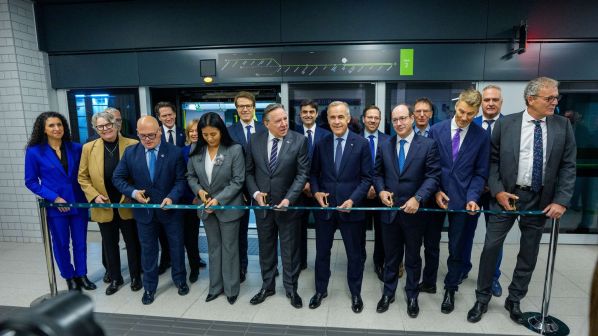
THE second section of Montreal’s Metropolitan Express Network (REM) officially opened to the public on November 17. Part-financed by the Quebec Deposit and Investment Fund (CDPQ) under a public-private partnership (PPP) and delivered by the pension fund’s wholly-owned subsidiary CDPQ Infra, the section extends the automated light metro system by 33km and adds 14 stations between downtown Montreal and Deux-Montagnes.
After seven years of construction, the REM network now stretches to 50km and serves a total of 19 stations. It links the North and South shores to downtown Montreal, with stations on the West Island, and provides direct access to three of Montreal’s four metro lines, as well as the commuter line to Mascouche.
The first section of REM, connecting Brossard on the South Shore with Montreal Central station, opened in 2023.
“For the first time, REM users will be able to cross Greater Montreal from Brossard to Deux-Montagnes,” says CDPQ Infra. “This new route marks a major transformation in public transport in the metropolitan area.”
When the sections to Anse-à-l’Orme and Montreal-Trudeau International Airport open in spring 2026 and 2027, respectively, the network will have 26 stations, extend to 67km and will be able accommodate up to 170,000 passengers.
For the REM project, Alstom is delivering a complete driverless light metro system, including 106 two-car Metropolis trains, Urbalis GoA4 CBTC for driverless operation, an Urbalis Vision control centre system, platform screen doors, onboard Wi-Fi connectivity, and cybersecurity. Alstom has also supplied has also provided equipment for two depots and two train washing facilities.
Pulsar, an Alstom-AtkinsRéalis joint venture, operates and maintains REM under a 30-year contract. Maintenance teams use Alstom’s HealthHub predictive maintenance tool that monitors fleet and infrastructure condition in real time, with AI-based data analysis.
For detailed data on metro projects across North America, subscribe to IRJ Pro.