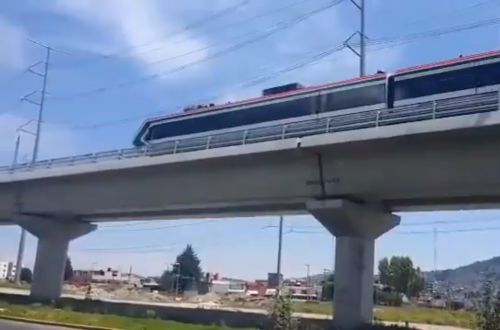
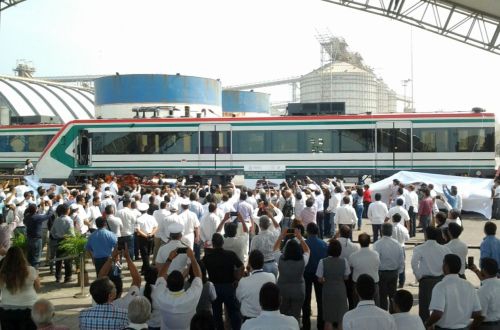
THE long-running project to build a 57.7km commuter line between Mexico City and Toluca was completed on February 2 when the president of Mexico, Claudia Sheinbaum, opened the final 8.4km section from Observatorio to Santa Fe.
The project has required a total of investment of Pesos 100bn ($US 5.79bn), according to the Mexican government. Tendering for the project began in 2014 when the new line was expected to open in 2017.
The final section starts at the Observatorio terminus where there are three platforms. Interchange is provided with Observatorio station on Line 1 of the Mexico City metro. There is one intermediate station at Vasco de Quiroga, and other major civil works included the construction of a 515m-long double cantilever cable-stayed bridge.
The completed Mexico City - Toluca line has a total of seven stations, including Lerma, Tecnológico (Aeropuerto) and Pino Suárez between Santa Fe and Toluca Centro. It is expected to carry up to 140,000 passengers a day, with trains operating every 12 minutes and providing an end-to-end journey time of less than 60 minutes compared with 2h 30min by road.
The fleet comprises 20 100m-long EMUs, each able to accommodate up to 719 passengers at a maximum speed of 160km/h. Rolling stock has been supplied by CAF as the leader of a consortium, also comprising Thales, Isolux-Corsán and Azvi, which in December 2014 was awarded a €690m contract to supply railway systems, including traction power supply and substations. CAF Signalling has supplied ERTMS, ATO and the control centre.
As of January 30, the Santa Fe - Toluca section had been in operation for 869 days, its five stations handling a total of 15 million passengers at an average of 22,000 a day, the busiest stations being Santa Fe and Toluca Centro. The eight trains in service had covered over 5 million km.
“This is not only a train that travels from Toluca to Mexico City, but it is also a completely different vision of recovering public space and integrating working-class neighbourhoods into a world-class transport system,” says Sheinbaum.
For detailed data on Latin American rail projects, subscribe to IRJ Pro.