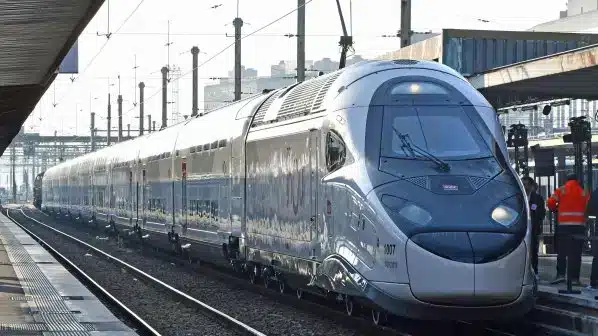
THE French government has signed an action plan with operators, manufacturers, industry organisations and the regions which fund new train orders, aiming to improve the management of rolling stock procurement programmes and reduce delivery times.
From the railway sector, the plan has been signed by national passenger operator SNCF Passenger and the French Rail Association (Afra) which represents new entrants, as well as infrastructure manager SNCF Network, and Paris metro and commuter operator RATP. Suppliers Alstom, CAF and Wabtec are also signatories, together with French railway industry association FIF.
Other signatories include railway safety regulator EPSF, Paris regional transport authority Île-de-France Mobilités (IdFM) and UTPF, an association representing the public transport and rail sectors.
The action plan is the result of work commissioned by government last year following recent delays to new train deliveries. This has examined root causes throughout the rolling stock value chain, from initial tendering to obtaining authorisation to place a new train in service, and has identified where performance needs to be improved in the context of the domestic passenger market opening up to competition.
Better cooperation
The plan is structured around three priorities which will be tackled by 10 working groups. The first priority is to strengthen cooperation between central government, the regions, operators and manufacturers and throughout the supply chain, in order to better anticipate risks, share best practice and fully involve SMEs.
A charter will be developed to formalise the commitments made by the rolling stock manufacturing sector, aiming to improve dialogue between project partners, anticipate risks and support for SMEs. A specific project will aim to secure the supply chain, identifying critical bottlenecks and monitoring performance indicators such as adherence to project milestones, quality, and on-time delivery.
Anticipating user needs
The second priority is to strengthen project management upstream of new rolling stock contracts by anticipating user needs and the requirements of transport authorities by defining a better framework for future tenders. Manufacturers will be provided with clearer visibility of rolling stock needs over the next 15 years, while innovation and production challenges will be taken more fully into consideration from the outset of fleet procurement projects while assessing the impact on existing infrastructure.
Work will include developing a guide to best practice in project management, including recommendations for public procurement, as well as better integration of cybersecurity and connectivity issues.
More standardisation
The third priority is to secure the execution of existing contracts, and the testing and approval of new rolling stock, by standardising project milestones and simplifying regulations.
The action plan aims to clarify applicable requirements and to identify opportunities for simplification, particularly where regulations overlap. Work on new train testing will aim to better organise the testing process and reduce delays, recognising where possible testing carried out for other approval authorities.
This work will draw on European comparisons, analysis of existing test protocols, the capabilities of test sites, and the contribution that can made by new technology including digital twins. “The goal is to improve efficiency and predictability, not to lower standards,” the transport ministry says.
Under the action plan, during the second half of this year assessment will continue and common frameworks will be developed. From next year, the measures outlined in the plan will be progressively integrated into tenders, new train delivery programmes and initiatives by manufacturers to improve production processes.
“This plan must enable manufacturers to strengthen their position, the market to anticipate the effects of opening up to competition, and the entire sector to prevent the recurrence of past delays,” says transport minister, Philippe Tarabot.
“Our ambition is to make the French rail sector the most efficient and competitive in Europe,” says industry minister, Sébastien Martin. “This requires better collaboration and giving our manufacturers the visibility they need to invest and innovate.”