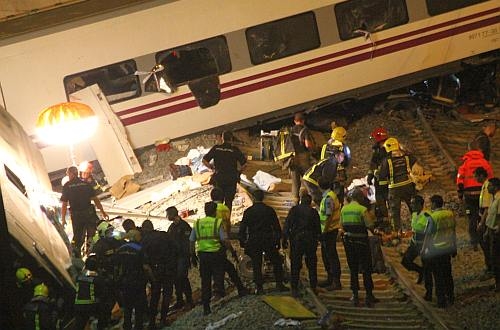
SPAIN’s Rail Accident Investigation Commission (CIAF) is investigating a broken rail as the possible cause of the derailment which took place January 18 at Adamuz on the Madrid - Seville high-speed line.
The last three cars of Iryo train 6189, travelling from Málaga to Madrid, left the track and fouled the adjacent line, colliding with Renfe train 2384, running in the opposite direction from Madrid to Huelva. The impact caused the first two cars of the Renfe train to fall down a 4m-high embankment. CIAF says that 43 passengers and two members of staff were killed, with 29 passengers sustaining serious injuries.
In an update on its investigation published on January 23 that presents its initial findings, CIAF says that the area where the rail broke corresponds to a weld between two sections of rail. Samples of rail were collected from the derailment site for laboratory analysis, and an on-site inspection of the wheels on the right-hand side (in the direction of travel) of the Iryo train was also carried out.

This inspection revealed notches on the tread of the wheels on the odd axles of cars 2, 3, 4 and 5. The notches have a uniform pattern in cars 2, 3 and 4 and are consistent with an impact on the rail head. The notches and the deformation observed on the rail are also consistent with the fact that the rail was fractured.
CIAF says that the fact that the notches are only present on the wheels of the odd axles of the train is consistent with the first wheel of each bogie receiving the impact of the broken rail head.
The notches present on car 5, on the right wheels of axles 17 and 19, have a different pattern, consistent with an impact against the rail head in a position that is not continuous with the area prior to the fracture. The fact that these notches are found on car 5, and that car 6 was the first to derail, is consistent with the rail tipping outwards to the right during the passage of car 5, so that car 6 derailed due to a complete lack of continuity in the running surface.
Tilted rail
It was observed on site that the rail, after the point of breakage, had ended up tilted outwards and with marks of having been run over sideways by a wheel once it had fallen over.
The wheels of cars 6, 7 and 8 were not examined as any marks or traces would have been erased. After derailing, they travelled a long distance, hitting ballast, sleepers and other elements of the track infrastructure. CIAF says these cars would presumably have derailed without touching the rail head after the breakage.
In addition to the notches found on the derailed Iryo train, notches with a compatible geometric pattern have been detected on the treads of some righthand wheels of three different trains that had travelled through the area prior to the accident.

Based on the available information, CIAF says that it can be assumed that the rail break occurred prior to the passage of the Iryo train involved in the accident and the derailment. It cautions that these findings are provisional and are subject to verification during the next phases of the investigation, which will include metallographic examination of rail samples to determine the possible causes of the break.
The only valid conclusions will be those presented in CIAF’s final report, the commission says, noting that its technical investigation has the sole objective of helping to improve safety, preventing future accidents or mitigating their consequences, with CIAF not seeking to determine blame or responsibility.
Track renewal
Following the publication of the CIAF update, Spain’s minister of transport and sustainable mobility, Óscar Puente, held a press conference to provide details of track renewal undertaken at Ademuz prior to the accident. He also spoke about inspection undertaken by infrastructure manager Adif to ensure the quality and robustness of this work.
Infrastructure renewal on the Guadalmez - Córdoba section of the Madrid - Seville high-speed line included turnout replacement at Adamuz, which was commissioned on June 20 2025. Following track renewal, Puente said that the 114 rail welds on the section were inspected and formally accepted, this approval valid until November 2026. This included the rail weld in question at Adamuz.
Subsequent inspection by Adif had revealed no faults. Last year track geometry was checked twice, on September 9 and October 13, with dynamic inspection using onboard equipment to monitor the interaction between track and train taking place five times between June and November.
Ultrasonic track inspection was undertaken on November 10. A manual inspection on foot took place on October 5 and the turnouts were inspected on January 7. Tamping was undertaken 13 times during 2025, the most recent occasion on November 6.
“In the 30 years of high-speed rail in Spain, there had never been an accident with such consequences and characteristics,” Puente said.