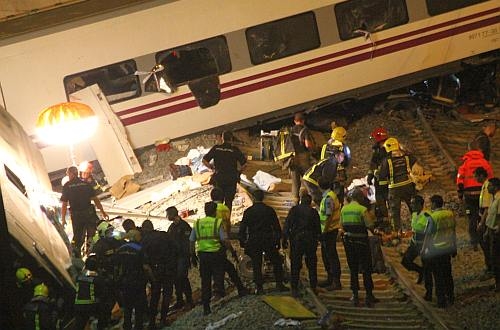
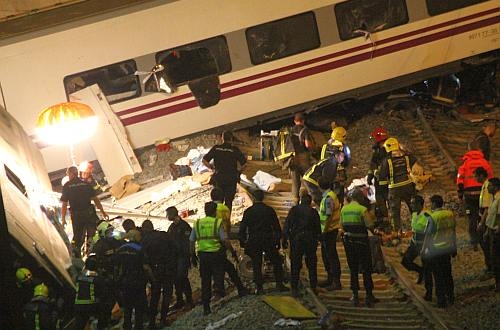
AT least 40 people have been killed following a derailment and subsequent train collision that took place at 19.45 on January 18 at Adamuz, north of Córdoba on the Madrid - Seville high-speed line in Spain.
The last three cars of Iryo train 6189, which left Málaga at 18.40 bound for Madrid, derailed and fouled the adjacent line, colliding with Renfe train 2384, an Alvia service running in the opposite direction from Madrid to Huelva. With the precise figure yet to be confirmed, both trains are believed to have been travelling at around 200km/h, according to a statement issued by the Ministry of Transport and Sustainable Mobility.
The impact caused the first two cars of the Renfe service, which was carrying a total of 186 passengers, to fall down a 4m-high embankment. According to Spain’s minister of transport and sustainable mobility, Óscar Puente, most of those killed and injured were travelling in the front two cars. Provisional casualty figures are 29 people seriously injured and a further 123 sustaining light injuries.
Iryo says that as well as the driver, 289 passengers and four members of staff were onboard the Málaga - Madrid service, operated with a Frecciarossa 1000 high-speed train. Iryo began operating on the Madrid - Seville high-speed line on March 31 2023.
The Madrid - Seville high-speed line opened in 1992 and Adif has begun a €700m upgrade programme including civil works, track and catenary renewals, and the installation of ETCS Level 2.
Puente has described the incident as “extremely strange," according to the BBC, telling local media that all the railway experts consulted by the government “are extremely baffled by the accident.”
Iryo notes that the derailment took place on a straight section of track. It says that the Frecciarossa 1000 train involved was built in 2022 and had last been inspected on January 15.
Having sustained serious damage, the Madrid - Seville high-speed line remains closed until further notice, with services from Madrid to Córdoba, Seville, Málaga, Huelva, Cádiz, Algeciras and Granada suspended. Once the trains have been removed from the site of the accident, infrastructure manager Adif says that damage will be assessed and all technical and human resources mobilised to reopen the line to traffic.
An investigation is now underway by Spain’s Rail Accident Investigation Commission (CIAF). Following a site inspection, CIAF has determined that laboratory testing will be required of rail at the location where the derailment was initiated.
A workshop inspection of the wheelsets fitted to the Iryo train will also be conducted, as well as examining the wheelsets of other trains operating over this section. Adif has been requested to provide details of trains operating through Adamuz over the two days before the accident.
CIAF is required by law to publish its final report on the accident within 12 months.