CONSTRUCTION of the immersed tunnel beneath the Fehmarn Belt, a key component of the new 160km railway between Denmark and Germany, will proceed this spring after the specially-designed vessel that will submerge sections of the underwater tunnel was finally approved for operation by the Danish Maritime Authority.
Danish state-owned company Sund & Bælt, which will own the 18km tunnel, confirmed in October that delays with testing and securing approval for the vessel, Ivy, had resulted in an 18-month delay to its deployment.
In a statement issued on April 2, the company said that construction of the tunnel is now delayed by at least two years but that its contractor, Femern Link Contractors (FLC), is preparing to start operations with Ivy later this month. Sund & Bælt added that it will offer an update on the overall project schedule once the first tunnel elements have been immersed. The €7.4bn project was originally scheduled for completion in 2029.
The immersion process
FLC has been working to prepare the initial section of the 12m-deep dredged trench in which it will immerse the tunnel elements. Ivy is formed of two units, Ivy 1 and Ivy2, which provide buoyancy to each 217m-long standard tunnel element, which consists of nine preassembled segments and is attached at each end to the vessels.
For the 39m-long special elements, the two vessels are joined to form a single vessel to facilitate the immersion process. Together Ivy 1 and Ivy 2 are equipped with 23km of steel hawser and 66 winches, which enable the vessel to precisely submerge the tunnel elements to a depth of 40m. The tunnel will require the submersion of 88 elements in total.
“Ivy is a unique vessel developed exclusively for the construction of the Fehmarnbelt Tunnel,” says Lasse Vester, deputy contract director at Sund & Bælt. “Its task is complex, so a long sequence of tests had been necessary to ensure that it meets the high technical and safety requirements set by both us and the authorities.”
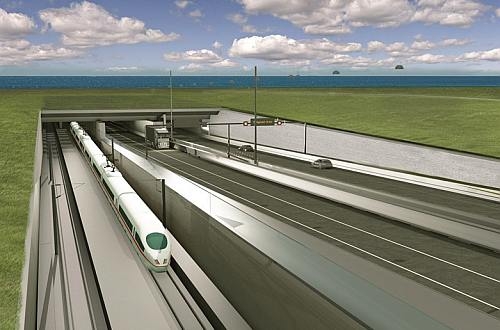
The tunnel will consist of five tubes, two single-track rail tunnels, two for two-lane roads, and a service tunnel. It will help to reduce Copenhagen - Hamburg journey times by rail from 4h 30min to 2h 30min. While the tunnel is facing delay, construction of a new 110km double-track line from Ringsted to Rødby in Denmark to connect with the tunnel is on schedule for completion in 2029.
For detailed data on European rail projects, subscribe to IRJ Pro.