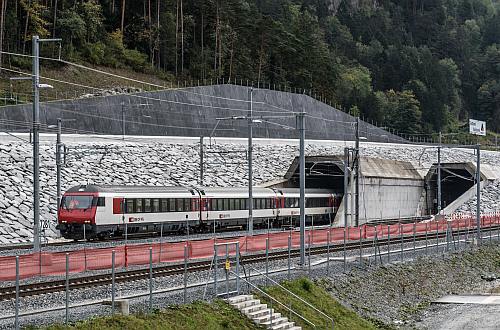
SWISS Federal Railways (SBB) has commissioned new derailment detectors on the approaches to the Gotthard Base Tunnel, installed in response to the freight train derailment in the western bore on August 10 2023. This resulted in the total closure of the world’s longest rail tunnel for several weeks, causing significant disruption to the European rail freight network.
The trackside detectors were commissioned during the night of May 10-11, installed at 10 locations on the approaches to the base tunnel. They cover the 230km/h high-speed crossovers located at both tunnel portals, sections of track that SBB describes as being particularly sensitive.
Commissioning of the derailment detectors has enabled SBB to lift the 160km/h temporary speed restriction in force at both crossovers, in place since the Gotthard Base Tunnel fully reopened on September 2 2024. This followed work to repair the extensive damage resulting from the derailment, which was caused by a broken wheel on a wagon.
SBB says derailment detectors are the only proven technology for detecting a derailment on the infrastructure side, and have been installed with the aim of preventing a collision between two trains should a derailment occur.
Derailment detectors cannot prevent derailments, however, which according to SBB requires better wagon maintenance and changing the law on liability in rail freight operations. At present, the operator moving the wagon is liable if an accident is caused by a defective wagon, not the wagon owner.
“Wagon keepers therefore have little incentive to invest more than the absolute minimum in wagon safety,” SBB says. “Liability legislation must therefore be amended.”
The most important measure will be a significant improvement in wagon maintenance, and SBB says that it supports the new regulations introduced by the Federal Office of Transport (FOT) following the derailment. Wagon owners and maintenance providers have until December 31 2026 to meet new requirements for minimum wheel diameters, more frequent maintenance based on distance travelled, and better wagon inspection, but the new regulations have been widely criticised by wagon owners.