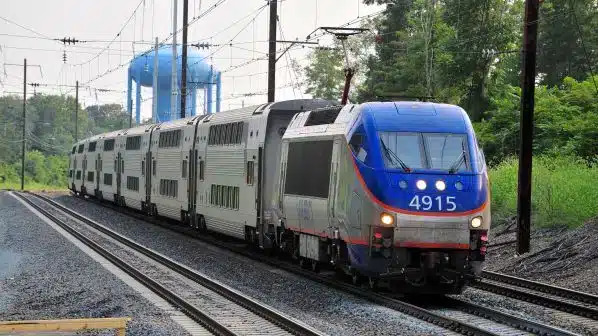
MASSACHUSETTS Bay Transportation Authority (MBTA) and Maryland Transit Administration (MTA) have issued a joint request for proposals (RFP) for the supply of commuter locomotives, with MBTA and MTA seeking to acquire 15 battery-electric locomotives capable of operating under overhead catenary and on battery power.
Procurement is being led by MBTA which is also inviting proposals for the supply of 10 diesel locomotives compliant with US Environmental Protection Agency (EPA) Tier 4 emissions standards. Proposals must be submitted by June 3 and contract award is planned later this summer.
The selected bidder will supply 10 battery-electric locomotives to MBTA and five to MTA to haul Maryland Area Rail Commuter (Marc) services. The latter will replace the Marc fleet of HHP-8 electric locomotives which are nearing the end of their useful life, while supporting “regional and state decarbonisation goals through the adoption of proven, next-generation propulsion technologies.”
The RFP notice also says that MBTA is procuring “a modern, energy-efficient, and environmentally responsible fleet” to replace all F40 and GP40 diesel locomotives currently in service, the former being rebuilt freight locomotives dating from the 1970s. The battery-electric locomotives are expected to be initially deployed on MBTA Providence Line services operating on the electrified Northeast Corridor (NEC).
MBTA says that the faster acceleration of its new battery-electric locomotive fleet will improve punctuality and offer the potential for increasing service frequency.
For MBTA, the contract will include options to supply up to 50 additional diesel or battery-electric locomotives. These options will be exercised in batches of five or more, with the propulsion type to be determined at the time of execution.
There are also options to supply up to 23 additional battery-electric locomotives to MTA, including additional capital spares. These options will exercised in three batches of five locomotives each, and one batch of eight additional locomotives.
“Battery-electric locomotives produce zero tailpipe emissions and are significantly quieter than traditional diesel trains, improving air quality and reducing noise along rail corridors,” MBTA says.
“By replacing aging equipment that is more prone to mechanical failures, the new trains will also help reduce delays and improve day-to-day reliability.”
For detailed data on locomotive orders worldwide, subscribe to IRJ Pro.