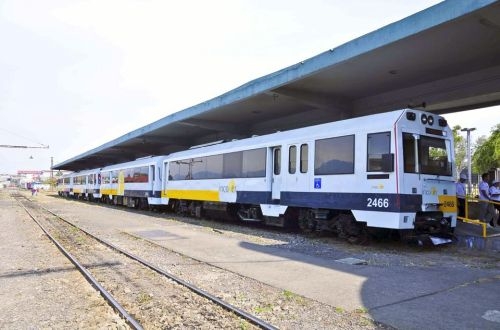
EIB Global, the development arm of the European Investment Bank (EIB), has signed an agreement to lend Costa Rica $US 250m for the Electric Train project to upgrade and electrify lines serving the capital, San José, and introduce tram-train services.
EIB says that its first loan to Costa Rica will fund infrastructure work on lines 1 and 2, which will run from Atlántico station in central San José to Paraíso and Alajuela respectively, as well as the acquisition of 28 LRVs. Services will operate every 10 minutes seven days a week.
The total cost of the first two lines is $US 800m. The project will be delivered by national railway Incofer, financed by a package of development funding under the terms of a bill that the government will lay before the Legislative Assembly.
Alongside the EIB Global loan, the Central American Bank for Economic Integration (Cabei) is providing $US 550m, of which $US 178.7m will be co-financed by the Green Climate Fund (GCF) which is also providing $US 21.3m in the form of a donation.
The Electric Train project comprises a total of five lines running for a total of 84.9km, which are:
- 1. Atlántico - Paraíso, 27.4km with 16 stations
- 2. Atlántico - Alajuela, 21.6km with 15 stations
- 3. Atlántico - Ciruelas, 25.4km with 14 stations
- 4. Alajuela - Ciruelas, 7.8km with five stations, and
- 5. Ciruelas - El Coyol, 2.7km with two stations.
The project is expected to significantly improve public transport in the greater San José metropolitan area with a population of over 3 million, providing better access to jobs and education and delivering a significant reduction in journey times.
EIB Global says that the new network has been designed to be inclusive, with a particular focus on women who make up the majority of public transport users and have less access to private motorised transport. At the same time, the project is expected to reduce CO2 emissions by 18,000 tonnes a year, contributing to Costa Rica’s climate change commitments and capitalising on the country’s nearly 100% renewable energy generation.
“The Electric Train is no longer just a dream,” says the president of Costa Rica, Rodrigo Chaves.
“Unlike previous proposals that were unsustainable, this one is solid, fiscally responsible, and will not require state subsidies.”
“We set out to optimise this project with a clear vision: to deliver Costa Ricans a solid proposal aligned with the real needs of the population, without unnecessarily indebting the country,” says Incofer executive president, Álvaro Bermúdez Peña.
For detailed data on rail and transit projects in Latin America, subscribe to IRJ Pro.