SOUTH Africa’s Ministry of Transport has launched consultation on the draft of the inaugural National Rail Masterplan (NRMP), a strategic framework intended to guide the development, modernisation and integration of the national network over the next 30 years and beyond. Consultation runs until July 22.
Requiring investment of Rand 1.9 trillion ($US 114bn), the NRMP aims to restore rail as a strategic national asset supporting economic growth, enabling efficient supply chains, and facilitating passenger transport with a focus on commuter journeys.
In her foreword to the draft NRMP, minister of transport, Barbara Creecy, says that the rail network in South Africa has been constrained by ageing infrastructure, evolving logistics patterns, operational challenges and declining investment. Meaningful reform of the sector requires both infrastructure investment and institutional change, Creecy says.
The future rail system will be characterised by improved governance, greater private-sector participation, open access, stronger regulation and a clearer separation between infrastructure ownership, infrastructure management and freight and passenger operations. This policy framework will be completed by a National Rail Bill that will address governance, access rights, infrastructure management, and operational standards, creating a cohesive regulatory environment.
Freight priorities
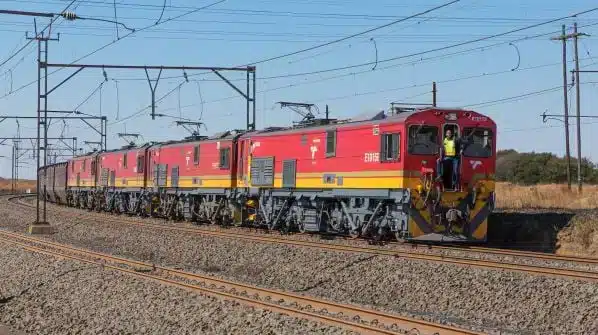
The draft NRMP says that the national network operated by Transnet carried 150 million tonnes in 2022, meeting 60% of demand from a viable rail market estimated at 262 million tonnes. This resulted in domestic and export commodities failing to reach markets or doing so uncompetitively, increasing logistics costs and generating unnecessary external costs as freight moved by road.
The national network currently moves commodities valued at Rand 273bn, while the draft NRMP says that it could be handle commodities worth Rand 1.3 trillion, reducing national freight costs by Rand 50bn.
At the same time, the 23,540km national network is oversized relative to economic output, constituting 2% of global rail infrastructure while South Africa’s GDP is less than 0.4% of global GDP. Around 20% consists of ringfenced systems for export commodities, including the Ore and Coal lines, but 40% of the network has no economic value and is of limited socio-economic benefit.
Of the remaining 40%, the draft NRMP says that half could form a core backbone used by multiple operators as part of supply chains between major centres, with the other half acting as dedicated feeder systems. The NRMP aims to analyse these components comprehensively, “avoiding both premature abandonment of potentially valuable infrastructure and rationalisation without due process.”
Rail infrastructure also suffers from serious neglect. Independent technical assessments have concluded that Rand 10bn is needed to rehabilitate the Ore Line and Rand 10bn for the Coal Line. On a conservative basis, it is estimated that a further Rand 50-100bn may be required to restore the core and feeder networks, with the NRMP exploring both private-sector and government funding options.
Signalling will also require investment as existing equipment is outdated, vulnerable to vandalism and inadequately maintained. “These deficiencies necessitate approximately 250,000 manual train authorisations monthly, introducing substantial inefficiencies and safety concerns throughout the system,” the draft NRMP says.
Introducing third-party access to the rail network is central to driving efficiencies and enhancing competitiveness and the NRMP aims to position rail freight in markets where it can perform at its best, covering an appropriate mix of trainload, intermodal and wagonload services.
Passenger development
The draft NRMP says that current performance of commuter networks operated by the Passenger Rail Agency of South Africa (Prasa) is hampered by inadequate infrastructure, low service frequency, and fragmented integration with other modes.
The NRMP development strategy includes reconfiguring commuter networks, separating freight and commuter operations, and introducing high-frequency services. These initiatives are expected to have relatively short lead times and modest funding requirements compared with other projects in the NRMP, with many foundational elements already in place.
The NRMP calls for the introduction of competition by means of awarding operating concessions for the individual networks operated by Prasa. Combined with new rolling stock, high-frequency services, and operational reforms, this is intended to position commuter as a central component of South Africa’s urban mobility framework.
The future of long-distance and regional passenger services “lies in a modern, shared-use standard-gauge high-performance national network,” according to the draft NRMP. The introduction of 1435mm-gauge on key corridors is expected to reposition rail as a credible alternative to long-distance road travel, making possible the introduction of double-deck rolling stock incompatible with the current gauge of 1067mm.
Where justified, standard gauge would be progressively introduced on priority corridors for passenger and intermodal freight traffic. Key freight routes would also be upgraded, with work including track doubling, extending passing loops, resignalling, traction power supply upgrades and increasing yard capacity.
“Rail has played a foundational role in South Africa's development,” Creecy says. “With the right reforms, investment and partnerships, it can once again become a catalyst for growth, inclusion and national development in the future.”