Sekisui's FFU synthetic sleepers have been deployed on 1400km of switch and bridge track sections in 16 countries since they were introduced over 30 years ago. Japan's Railway Technical Research Institute returned to two early installations in Japan to evaluate the sleepers' performance.
SEKISUI's fibre-reinforced foamed urethane (FFU) sleepers were devised as a synthetic alternative to traditional wood sleepers that would offer the same performance but a far longer life span and with better resistance to the elements.
 FFU sleepers were first installed in 1980, and are now in use on more than 1400km of track sections at switches, tunnels and bridges in 16 countries. FFU's latest customers are British infrastructure manager Network Rail, which introduced the sleepers for the first time on two bridges in September 2014, and Belgian infrastructure manager Infrabel, which also completed a bridge installation earlier this year.
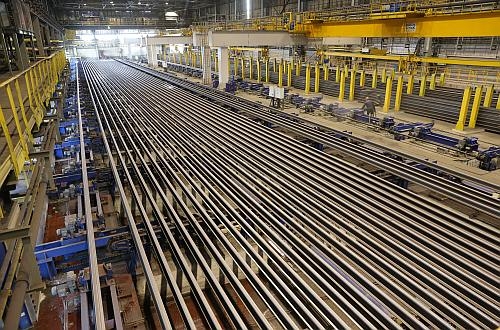
FFU is produced by compressing single strands of glass fibre with polyurethane foam using a high-pressure extraction press. The manufacturing process is initiated by mixing the base materials polyole and isocyanide with several additives, and after compounding and extrusion, the raw mixture is reinforced with long glass fibres. Foaming and curing then takes place before the finished product is cut to a standard length of 12m for further processing and sizing to any length determined by customers.
One of the major benefits of the sleepers is their longevity. This was recently demonstrated in a study conducted by Japan's Railway Technical Research Institute (RTRI) on behalf of Sekisui of FFU synthetic short sleepers and FFU synthetic bridge sleepers which have been in service in Japan for the last 30 years.
Specifically the study looked at bi-block or short sleepers used in the Kanmon tunnel on the Sanyo Main Line on Kyushu Railway, and bridge sleepers on the Miomotegawa bridge on JR East's Uetsu Line.
In total 74 sleepers consisting of 37 pairs were installed in Kanmon tunnel, with dimensions of 120x240x590mm, with 60kg rails and gate-type rail fasteners used. The alignment is straight with a 2.2% gradient and the passing tonnage per year is 18.9 million tonnes, which equates to 52,000 tonnes per day, and in the past 30 years, 580 million tonnes.
Kyushu Railway Company has carried out the following maintenance procedures on the short sleepers since installation:
- 1984: replaced sleeper plates
- 1985: replaced rails
- 1991: replaced rails
- 1996: replaced rails
- 2002: replaced rails, and
- 2005: replaced sleeper plates
The survey results show that after 15, 20, 25, and 30 years in service the short sleepers exhibited no cracks and warping, no changes in the colour of the surface layer, and no loose screw spikes, and overall were in good fixed condition. Furthermore, the sleeper plates were in good fastened condition, while no peeling or cracks, or loose sleepers were found during observations of the bonded portions from the ditch side.
In addition, screw spike pull-out tests were carried out. These consist of drilling an 8.5mm-diameter pin hole in the head of the screw spike, inserting a pin in the hole to use it as a pull-out jig, and then connecting the pin to the embedded plug pull-out testing equipment. The results indicated that the pull-out strength of screw spikes of the FFU short sleepers fell within the range of 23.3-50.4kN with an average of 32.5kN, which exceeds the average value of 30kN of the pull-out strength of screw spikes under JIS E 12031.
Tests of the screw spike unfastening torque were also conducted which consisted of fixing a short sleeper to a test bench to unfasten the screw spike with a wrench and measure the torque of the moment. The measurement was continued until the unfastening torque on the screw spike started to decline. Like the torque tests, the screw spike unfastening torque fell within the range of 163 to 336Nm with an average torque of 223.7Nm.
The required torque to unfasten a screw spike varied between screw spikes, but according to the comparison it was roughly equal to that obtained from the result of a survey of sleepers after 10 years in service. Consequently, any drop in torque to unfasten screw spikes is hardly noticeable.
The results of the physical property tests show that the sleepers continue to meet JIS E 12031 and ISO 12856-1 standards. In addition, when comparing the average specific gravity of specimens by years in service, the average after 15 years with 680kg/m³ was almost the same as that of the specimens used in the latest tests.
Bridge tests
Tests were also carried out of bridge sleepers on the Miomotegawa bridge. In total 18 200x200x2700mm sleepers were installed on the line in 1980, with 50kg rails with F-shaped rail fasteners fixed with dog spikes used for the straight alignment, which has a gradient of 4.4‰.
Annual passing tonnage on the bridge is 6.1 million tonnes, which means the sleepers have carried 180 million tonnes over the last 30 years. According to the past survey results and data from JR East, no track maintenance was performed for a period of 20 years after the sleepers were installed.
The survey results show that the bridge sleepers exhibited no cracks and warping on their surface and no peeling of the bonded surface in the bonded area. Even though some of the dog spikes had loosened, and the dog spike's head had reduced due to corrosion, the FFU bridge sleepers were generally in good condition.
The tests also show relatively strong correlations between the specimens used.
Bending fatigue tests were conducted at three sleepers under the following conditions. The specimens were cut out from bridge sleepers so that the longitudinal direction of the specimen was parallel to the fibre direction and the specimen measured 30x30x520mm. The load was applied perpendicular to the fibre direction and had a 420mm support span.
The maximum set bending stress was 70, 75, 80, 90, and 95N/mm² and the number of vibrations was up to 100 million.
Besides the bending fatigue tests, static bending tests were conducted with the objective of collecting data in order to convert the stress acting on each specimen in the bending fatigue test to an equivalent specific gravity. The static bending tests were conducted five times on one piece of each sleeper. The dimensions and support span of the specimens used to conduct the tests were the same as those used to conduct the bending fatigue tests.
If the results of FFU sleepers in service after 30 years are compared with the results of bending fatigue tests on the bridge sleepers after 15 years in service and on the new synthetic sleepers, it is clear that the strength of the bridge sleepers under the bending fatigue tests is declining. The stress on the bridge sleepers is 77.8N/mm² while the new synthetic sleepers is 94N/mm².
This demonstrates that the strength deteriorated by 16.2N/mm² in the past 30 years. However, since the results of the tests on the bridge sleepers after 15 years in service exhibited a 78.9N/mm2² stress that did not vary significantly from the results of these tests, no noticeable deterioration in the strength was observed.
Furthermore, if it is assumed that the axleload applied to the Shinkansen was 170kN, and the bridge sleepers were subjected to repeated stress due to trains passing at a frequency equivalent to that for sleepers in service for 50 years (or the originally estimated durability), the fatigue fracture-resistant strength of the bridge sleepers after 30 years in service came to about 74.8N/mm². This greatly exceeds the stress tolerance of 25N/mm² normally generated on bridge sleepers, and shows that the current FFU bridge sleepers will remain reliable for the next two decades.