India's Dedicated Freight Corridor projects promise to transform the country's railfreight activities. After years of delays work is now picking up, as Adesh Sharma, managing director of Dedicated Freight Corridor Corporation of India, reveals in an exclusive interview with Kevin Smith.
STRETCHING from Kolkata in the east to Delhi in the north and Mumbai on the west coast, India's plans for two new dedicated freight lines between industrial sites in three of its most important cities have long-promised to relieve pressure on its saturated rail network.
The initial hope was for services to begin in 2012. However, the early years were marked by political squabbles as the estimated cost of the Dedicated Freight Corridors (DFCs) mushroomed from Rs 420bn ($US 6.72bn) to Rs 960bn today.
Ten years have now passed since the projects were proposed, and nine since the Dedicated Freight Corridor Corporation of India (DFCCIL) was founded by the Indian government to plan and implement the schemes. When IRJ last reported in-depth on progress in March 2013 (p18), a Rs 33bn civil works contract for the 342km section of the Eastern DFC from Bhaupur to Khurja had just been awarded to a consortium of Tata Projects India and Aldesa, Spain, five years after contracts for the initial 122km section from Sonnagar to Mugalsarai. DFCCIL was also preparing to award its first civil construction contract for the Western DFC. A consortium of Sojitz, Japan, and Larsen & Toubro, India, subsequently won the Rs 67bn contract for the initial 625km section, or 40% of the project, from Rewari to Iqbalgarh in August 2013. Momentum was finally building.
During a conversation with Mr Adesh Sharma, DFCCIL's managing director, it is soon clear that while there have been difficulties in the preceding two years and that some challenges have not yet been overcome, the impetus remains.
Indeed with several substantial contracts set for award in the next 12 months, the projects are now reaching a critical stage with the government allocating Rs 93.2bn towards construction in its annual railway budget announcement on February 26. Rs 84.7bn will also go towards rolling stock procurement during the year.
"In the 2015 railway budget, the minister for railways [Mr Suresh Prabu] told the prime minister [Mr Narendra Modi] that this is India's largest infrastructure project and it is a government priority to develop the DFCs," Sharma says. "This is now the number one item in the wishlist of Indian Railways and the benefits it will offer when services begin are long overdue. Previously we had a desired timeline, but now that everything is in place and construction is underway, we are working towards a specific timeline and target to get these projects up and running."
 Civil works are now well underway on 464km of the 1839km Eastern DFC which will link Ludhiana with Dankuni, near Kolkata. The DFCs are double-track and designed to accommodate 32.5 tonne axleloads, although the line's equipment will initially be limited to 25 tonnes. Further contracts for the 402km section between Mughalsarai and Bhaupur will be awarded this month, at which point civil works will be progressing on 66% of the corridor.
Sharma says that DFCCIL plans to award 80% of the contracts by March 2016 and the remainder by June 2016 with the aim of completing the entire project by December 2019 following phased commissioning. This will begin with the Sonnagar - Mugalsarai section in December 2017, Bhaupur - Khurja in March 2018, Mughalsarai - Khurja in December 2018, and finally Khurja -Dadri - Ludhiana in December 2019.
The remaining 524km eastern section between Dankuni and Sonnagar is currently unfunded with the government seeking investors for this public-private partnership (PPP) project. Interest in the scheme has been limited leading to a delay in the past two years. And with land purchase continuing, DFCCIL says a Request for Qualification will be issued once 90% of land and the necessary clearances are secured.
Work on the Rewari - Iqbalgarh section of 1534km Western DFC from Dadri, southeast of Delhi to Jawaharlal Nehru Port (JNPT) near Mumbai is on schedule for completion by December 2018. The remainder of the corridor will be completed by December 2019 with contracts for the Iqbalgarh - Vadodara (325km), Vadodara - JNPT (425km), and Dadri - Rewari (127km) sections due to be let this year and in early 2016 with the aim of all work starting by April 2016.
Setbacks
While DFCCIL and its contractors are clearly making progress, as India's largest railway infrastructure project in a generation, it is unsurprising that several political and technical issues have arisen in the past two years, leading to further setbacks and deadline extensions.
Sharma says that land acquisition is one of the main contributors to the delays. Around 300,000 people are directly affected by construction on the combined 3350km route, which encompasses 11,000 hectares of land with the cost of procurement estimated at Rs 80.67bn. While IRJ reported in March 2013 that 90% of the land had been secured, difficulties with the remaining sections led to reviews of certain stretches and the restart of some procurement processes.
The result was the allocation of extensive government rehabilitation and resettlement benefits to affected residents following the introduction of a new land acquisition bill. Sharma says that the land acquisition process is now 84% complete, and with these issues resolved, he is confident the remaining 16% will be secured by the end of 2015.
Other problems which held up early stage work on the Western DFC include securing mining rights in Rajashstan state following the National Green Tribunal abolition of these activities. Variations in laws in the nine states through which the lines pass have also led to problems. Likewise the civil works contractors are following International Federation of Consulting Engineer (FIDIC) protocol, which is rare in India. While this approach is improving safety for workers, particularly in areas where work is taking place close to existing lines, Sharma admits the unfamiliar emphasis on sharing of responsibilities is impacting the speed of decision making. Similarly he says the structure of the contracts is proving difficult to manage.
"This is the first time we have developed design and build contracts in India," Sharma says. "Previously we worked with itemised contracts, whereas design-build is a lump sum contract where the contractor has to do the design and then carry out the work, which is proving difficult because there is a lack of domestic expertise in what is required for track and bridge design and construction, for example."
The financing structure for the projects is also resulting in an unfamiliar approach to construction for Indian-based contractors.
While the Sonnagar - Mughalsarai section of the Eastern DFC is funded by the government at a cost of Rs 36.79bn, the World Bank is providing 66% of the funding for the remaining work with $US 2.075bn already in place and an additional $US 650m loan for the third phase expected by the end of the year. A $US 5.2bn soft loan from the Japan International Cooperation Agency (Jica) is funding 77% of the Western DFC, with the agreement stipulating that Japanese companies must be involved in the project.
These agencies have subsequently conducted extensive vetting of the civil works contracts, which according to Sharma took a significant amount of time again due to limited domestic railway engineering expertise. He adds that this lack of experience has hindered progress on preparing land for new construction.
"We have had difficulties with shifting overhead lines, moving utilities such as electricity cables and pipelines, and relocating bridges for highways and constructing underpasses," Sharma says. "There is also the challenge of passing different environmental clearances, particularly with the western corridor where this has taken a long time."
Track construction
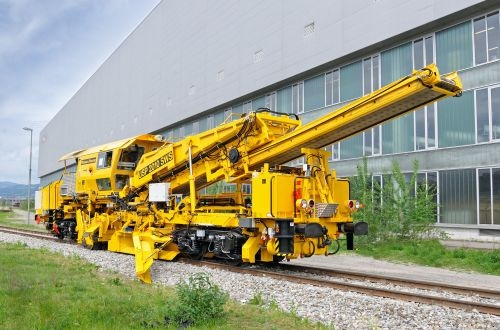
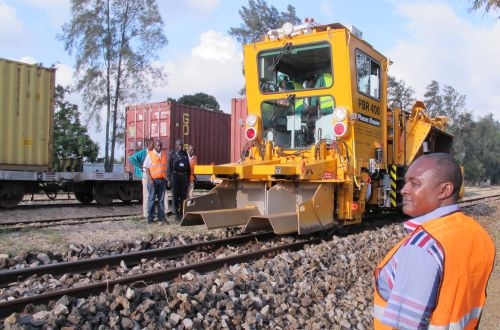
While teething problems have certainly been encountered during the civil works phase, the chosen method of track construction will save a significant amount of time compared with past projects. This is an entirely mechanised process, a first for India, with six to seven New Track Construction (NTC) machines required for the work. Five of the machines have already been ordered from Harsco, including one refurbished unit and two new machines for the Eastern DFC. The first of these was expected to reach the site by the end of last month, with the other currently under construction in the United States and scheduled for delivery in June. Two further machines have been ordered for the Western DFC, with one already in use on the Rewari - Iqbalgarh section.
The NTCs will lay 260m-long head-hardened rails utilising flash butt-welding. The machines are capable of laying 1.5km of track per day using minimal manpower, which contrasts with Indian Railways' (IR) conventional manual or semi-mechanical tracklaying method which produces around 1km in 10 days and requires up to 3000 trackworkers. Sharma estimates that Rs 1bn will be spent on the equipment, while Harsco also secured orders to supply two Mark VI production/switch tampers, one STM-XLC tamper and a TS-30 track stabiliser in February 2014.
"This has been quite a costly and time-consuming process, but once we get up and running and familiar with how the system works, it will be very easy for us to push ahead to complete the projects," Sharma says. "It will also have long-term benefits for other projects."
Another area that is proving particularly challenging is delivering the line's electrification system. The loading gauge on the Western DFC will accommodate double-stack containers, which IR says is a world first for an electrified line, with the contact wire positioned at 7.54m compared with 5.54m on conventional lines in India and the Eastern DFC.
Work is underway to rebuild existing road and footbridges to accommodate the new line. While in addition to its civil works contract, Sojitz and Larsen & Toubro secured a Yen 50bn ($US 416.9m) contract in November to supply and install 2x25kV 50Hz ac electrification equipment for the 915km Rewari - Vadodara section. Japanese products including cables and equipment for the 16 substations on the section, which are positioned 60-70km apart, account for around 40% of the order.
This system departs from India's traditional 25kV ac electrification supply by utilising a system used on other heavy-haul and high-speed lines around the world, which provides a power density of up to 1MVA per km required by high-powered locomotives hauling trains of up to 1500m in length and weighing 15,000 tonnes on a line with gradients of up to 0.5%.
Inevitably several innovations are required to operate trains with this greater clearance. For example Stone India has developed a new pantograph, Universal Intelli-Panto, which it says is the tallest in the world. Trials of the system began in 2008 and the company says it is ready to supply when required. The line is also equipped with a TCP/IP-based Scada power control system and remote terminal units at control posts.
Contracts to supply signalling and associated systems for the Khurja - Bhaupur section of the Eastern DFC and the Rewari - Vadodara stretch of the Western DFC will be awarded in May with the remaining contracts due to be issued in 2015-16. The chosen contractor will supply automatic block signalling and CTC systems along with electronic interlockings with an interface for local operation. Suppliers will also provide an onboard train protection system, while an SDH-based optical fibre network and GSM-R is proposed for telecommunications. One control centre is envisaged for each line, with the Eastern DFC control centre based in Allahabad, and the west's in Ahmedabad.
In addition to double-stack containers, the Western DFC will carry coal from ports along the Gujarat coast to the northern and northwestern states, while the Eastern DFC will primarily transport coal and other minerals from the north to industrial sites in the east.
An open-access operating model is proposed for the line with DFCCIL managing operations and responsible for infrastructure maintenance. However, IR will remain the sole operator of railway services in India with private companies not yet possessing the equipment or expertise to do so. IR is also set to maintain rolling stock, and Sharma says that IR plans to procure 200 7MW locomotives suitable for 25-tonne axleload operation on the corridors from a Japanese manufacturer, with the tender currently with the Ministry of Railways.
Sharma says that once the corridors open, 70% of traffic running on the existing lines will transfer to the DFCs and a significant amount of existing roadfreight is expected to shift to rail to take advantage of the enhanced service. The lines are expected to offer three to four times more capacity than at present with 150 trains running in each direction every day at an average speed of 65km/h compared with the current average of 25km/h for freight services, and a maximum speed of 100km/h compared with the present high of 75km/h.
"Most freight which takes two to three days to reach its destination now will take less than 24 hours when the DFCs come online," Sharma says. "It will also equate to savings of 470 million tonnes of CO² every year."
Studies by the World Bank and Jica estimate that the Eastern DFC will carry 264 million tonnes of freight and the Western DFC 284 million within 20 years of opening. However, Sharma feels these are rather conservative estimates. "There is a lot of industrial development alongside both corridors providing enormous growth potential," he says. "I am confident they will surpass these figures, probably within 10 years of the start of operations."
Sharma says his optimism is underpinned by the Delhi Mumbai Industrial Corridor (DMIC) initiative, a new $US 100bn state-sponsored industrial corridor, the driving force for which is the Western DFC. New industrial hubs planned at Sanand, Nasik, Pune and Sinnar, will connect with the Western DFC. In addition, similar hubs are planned at Rewari and Dadri to serve the Eastern DFC, while multi-modal logistics parks are envisaged in Delhi, Rewari, Ahmedabad, Vapi and Navi Mumbai, all of which could boost railfreight traffic.
Sharma says significant work is taking place to upgrade feeder lines to the DFCs from these industrial sites, mines, and ports at Mundra, Pipava and Kandla so they can accommodate 25-tonne axleloads. In addition JNPT is currently upgrading its facility to add a fourth terminal which will add 4.8 million TEUs to its annual capacity taking its total to 10.3 million TEUs, and reaffirming its status as India's largest container terminal.
Development of the Eastern and Western DFCs has inevitably led to calls for additional corridors. Four more routes are proposed - the east-west Kolkata - Mumbai corridor, the north-south Delhi - Chennai route, the east coast Kharagpur - Vijayawada, and the southern Chennai - Vasco da Gama corridors. However, progress on these projects is slow.
IRJ reported in 2013 that studies were due to be completed on each by the end of that year. Two years on and draft preliminary engineering and traffic studies for the east-west and north-south corridors have been submitted to the Ministry of Railways, while similar reports for the remaining two corridors are expected by the end of the year. Yet as PPP projects, the experience with the Dankuni - Sonnagar section of the Eastern DFC indicates that financial partners may not be forthcoming.
As we argue this month, the Indian government and IR have been guilty of dreaming big and losing focus on big ticket projects in recent years. With work on both these mammoth schemes finally delivering something concrete and many of the major hurdles now seemingly overcome, it is important to maintain this momentum so the DFCs can buck this trend. After all the DFCs, as Sharma points out, promise to play a critical role in not just Indian Railways' future, but India's overall logistical and industrial development in the 21st century.
"Rail used to account for 86% of freight in India and now it accounts for just 30%," Sharma says. "Our aim is to increase this to 50% and claim traffic back from road and inland water. Rail is the easiest, most efficient and fastest way to transport freight over long distances, and the DFCs are our answer to this problem."


 The course is already producing results. Since the first group of undergraduate students began work at HU in September 2012, 51 students have participated, and 48 have successfully graduated. There are currently 15 students enrolled, and of the first cohort of 16 students, five have taken a job within the industry, while some of the others are pursuing further studies in rail-related subjects. In addition, one student is now working for Arcadis as a mechanical engineer after developing an improved dropper for a catenary wire clamp during an internship. The solution does not require a temporary binding and offers an assembly cost saving of 10%.